ISO Certifications | Compliance Services | Data Security | Risk Management | Audit & Consulting & ISO Certifications | Compliance Services | Data Security | Risk Management | Audit & Consulting
About Us
Surkshanow is a global consulting firm specializing in compliance and management system consulting services. We help businesses strengthen security, achieve regulatory compliance, and build operational excellence through standards such as SOC 2, ISO 27001, HIPAA, GDPR, PCI DSS, and other international frameworks. With a client-focused approach and industry expertise, we support organizations in building secure, compliant, and future-ready businesses.
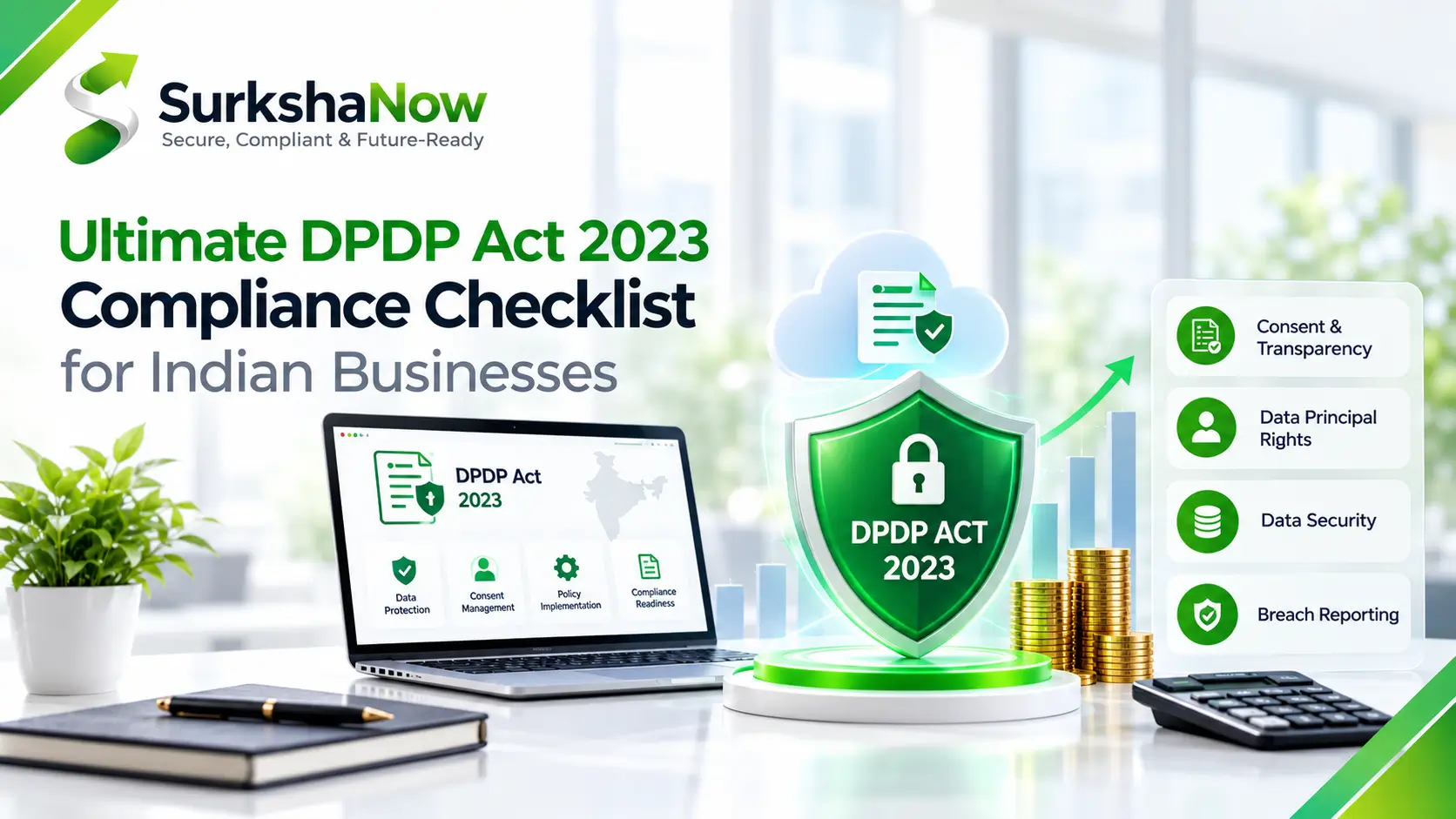
Ultimate DPDP Act 2023 Compliance Checklist for Indian Businesses
Is your business completely ready to meet India's new digital privacy requirements? The important Digital Personal Data Protection (DPDP) Act 2023 makes a fundamental difference to how organizations collect, process, and store personal data. If you run an e-commerce platform, a SaaS startup, an enterprise fintech, or a healthcare company, non-compliance is no longer an option.
Given that the financial penalties for data security breaches and for failing to comply with consent requirements can reach up to ?250 crore in each case, it has become a vital business priority to implement a robust DPDP Act 2023 compliance checklist.
This comprehensive checklist breaks down regulatory mandates into actionable steps, explains core obligations under the DPDP framework, and highlights how modern automated platforms like SurkshaNow streamline end-to-end data privacy compliance.
What is the DPDP Act 2023 and who is it applicable to?
The Digital Personal Data Protection Act of 2023 has established a statutory framework for processing digital personal data in India, striking a balance between an individual's right to protect their personal data and the need for organizations to process information for legitimate purposes.
Under the law, key entities are classified as:
Data Principal: The individual whose personal data is collected (customers, employees, leads).
Data Fiduciary: The organization that determines the purpose and means of processing personal data.
Data Processor: Any third-party vendor or entity processing data on behalf of the Data Fiduciary.
Significant Data Fiduciaries (SDFs): Organizations designated by the government based on data volume, sensitivity, or risk factors, subject to enhanced compliance mandates.
If your company handles the digital personal data of Indian residents—regardless of whether your headquarters are in Mumbai, Bengaluru, or overseas—the DPDP Act Compliance directly applies to you.
The Ultimate Step-by-Step DPDP Act 2023 Compliance Checklist
This practical checklist covers all operational areas to help Indian businesses move from a state of vulnerability to full audit readiness.
1. Execute Data Discovery & Personal Data Mapping
Before protecting customer data, you must locate all personal information across your ecosystem.
Map Data Assets: Identify structured and unstructured personal data across cloud databases, local storage, spreadsheets, CRMs, and HR tools.
Maintain Records of Processing Activities (RoPA): Document why data is collected, who has access to it, where it is transferred, and how long it is retained.
Classify Data Types: Distinguish between general user data, employee information, and sensitive data attributes.
According to Sections 5 and 6 of the Act, consent must be free, specific, informed, unconditional, and unambiguous.
Deploy Itemized Consent Notices: Provide clear, standalone notices stating the exact personal data collected and its specific purpose: no hidden terms or pre-ticked checkboxes.
Multilingual Accessibility: Ensure privacy notices are available in English and all 22 official Indian languages scheduled in the Constitution.
Simplified Withdrawal Options: Make withdrawing consent as simple and friction-free as giving it. When consent is withdrawn, processing must cease immediately.
Re-Validation for Legacy Data: Review historical user repositories and reissue updated consent notices where necessary.
3. Build Operational Workflows for Data Principal Rights (DSR/DSAR)
People currently have clear rights concerning their digital footprint. Indian businesses have to set up operational intake and execution pipelines:
Right to Access: Enable users to retrieve a summary of their processed data and details of third parties with whom it was shared.
Right to Correction & Erasure: Provide portal tools or workflows for users to complete, update, or purge their data once the original processing purpose is complete.
Right to Grievance Redressal: Appoint an accessible Grievance Officer and clearly display their contact info on web/app properties.
Right to Nominate: Allow users to designate an individual who can exercise their data rights in the event of death or incapacity.
4. Introduce Age-Restricted Systems and Safeguards for Children's Data
Under Section 9, processing data related to minors (individuals under 18) triggers strict requirements:
Verifiable Parental Consent (VPC): Implement age-verification controls to secure consent from parents or legal guardians before processing a minor's data.
Prohibit Targeted Tracking: Eradicate any behavioral monitoring, profiling, or targeted advertising directed at children.
5. Enforce Reasonable Security Safeguards & Data Retention Schedules
The technical security measures had to support the legal privacy policies.
Technical Security Standards: Apply robust data encryption (both at rest and in transit), strict Role-Based Access Control (RBAC), and zero-trust architectures.
Automated Data Purging: Establish retention rules that automatically delete personal data once the statutory or operational purpose ends or consent is revoked.
Data Breach Response Protocols: Formulate an incident management plan guaranteeing swift notifications to the Data Protection Board of India (DPBI) and affected users following a breach.
6. Vendor & Third-Party Processor Governance
You remain responsible for data processed by third-party vendor platforms.
Assess Cross-Border Data Flows: Verify that data transfers outside India comply with government-approved blocklists or regional restrictions.
Key DPDP Act Requirements: SDFs vs. Standard Fiduciaries
Depending on your organization's operating scale and classification, regulatory obligations vary:
Compliance Requirement
Standard Data Fiduciary
Significant Data Fiduciary (SDF)
Notice & Consent Framework
Required (Plain & Multilingual)
Required (Plain & Multilingual)
Data Principal Rights System
Mandatory
Mandatory
Data Protection Officer (DPO)
Recommended / Grievance Officer required
Mandatory (Must be resident in India)
Data Protection Impact Assessment (DPIA)
Optional / Good Practice
Mandatory (Periodic risk assessments)
Independent Data Audits
As per internal policy
Mandatory (Periodic external audits)
Data Breach Notification
Mandatory (DPBI & Users)
Mandatory (DPBI & Users)
How SurkshaNow Automates Your DPDP Act Compliance Journey
The process of manually maintaining consent records, monitoring multilingual notices, handling DSR requests, and updating vendor DPAs across an enterprise is likely to lead to errors. SurkshaNow offers an end-to-end platform for compliance with the DPDP Act 2023, tailored for businesses in India.
Core Features of SurkshaNow:
Dynamic Multilingual Consent Manager: Automatically deploy, translate, and serve itemized consent banners in English and all 22 scheduled Indian languages with real-time opt-in/opt-out synchronization.
Automated Data Discovery & Mapping: Scan your enterprise cloud infrastructure, databases, and SaaS tools to create and update your data inventory and RoPA automatically.
Unified DSR/DSAR Management Portal: Streamline access, correction, and erasure requests via an automated self-service workflow that adheres to statutory response timelines.
Centralized Audit Trail Repository: Log every consent update, policy revision, vendor agreement, and rights request within tamper-proof audit trails to ensure continuous audit readiness.
Business Benefits:
Eliminate Regulatory Penalties: Safeguard your business from potential penalties up to ?250 crore with automated compliance enforcement.
Accelerate Sales Cycles: Win enterprise clients faster by presenting verified DPDP audit readiness and robust vendor governance.
Build Consumer Trust: Deliver transparent privacy controls that reinforce brand credibility among Indian consumers.
Simplify Your DPDP Compliance with SurkshaNow
Achieving compliance with the DPDP Act is not a one-off task but an ongoing operational obligation. If you follow this checklist—identifying personal data, automating multilingual consent notices, protecting children's data, and securing system architectures—you will be able to operate with confidence in India's digital economy.
Ready to simplify your data privacy operations and protect your business against heavy penalties?
What are the financial penalties for DPDP Act non-compliance?
Penalties are decided for each case and there are no strict limits based on company turnover. If you do not put in place proper security measures and a data breach happens, you could face fines up to ?250 crore. Not following rules for protecting children’s data can lead to penalties up to ?200 crore.
How does the DPDP Act impact B2B companies?
Your business must follow the DPDP Act even if you do not sell directly to consumers. If you handle employee data, vendor contact details, or process data for clients as a Data Processor, the law still applies to you.
Can businesses rely on implicit or bundled consent under the DPDP Act?
No. The DPDP Act does not allow bundled consent, pre-ticked boxes, or implied consent hidden in general terms and conditions. Consent must be clear, specific, and supported by detailed notices.
Why is an automated solution like SurkshaNow essential for compliance?
Manually tracking consent withdrawals, handling different languages, and managing data deletion schedules can create gaps in your operations. SurkshaNow automates these tasks and helps keep your systems up to date with changing regulations.
Recent Insights
September 28, 2026
Master DPDP Act 2023 Compliance in India: The Complete Business Strategy
With the DPDP Rules notified, Indian businesses face strict compliance milestones leading to May 2027. Discover the phase-by-phase timeline, key requirements, and how SurkshaNow simplifies your DPDP Act implementation.
How to Choose the Right VAPT Company in India for Your Business
Don't let security vulnerabilities ruin your business reputation. Learn how to choose the right VAPT company in India and schedule your security audit with SurkshaNow!
How to Choose the Right SOC 2 Compliance Consultant for Your Business
Choose the best SOC 2 compliance consultant for your SaaS or tech firm. Discover step-by-step selection tips and how to fast-track SOC 2 Type 1 & 2 readiness.
Essential cookies keep this website working. With your permission, analytics cookies help us understand page visits. Optional tracking stays off until you choose. Cookie policy · Privacy policy