SOC 2 Type 1 vs Type 2: Which Report Does Your Business Need?
Compare SOC 2 Type 1 vs Type 2 compliance. Learn key differences in timeline, cost, and requirements to choose the right report with SurkshaNow.
Read More →
For SaaS entrepreneurs from India, FinTech innovators, and other rapidly growing technology companies, going global is a key objective. Yet international clients expect solid evidence that you can keep their data safe.
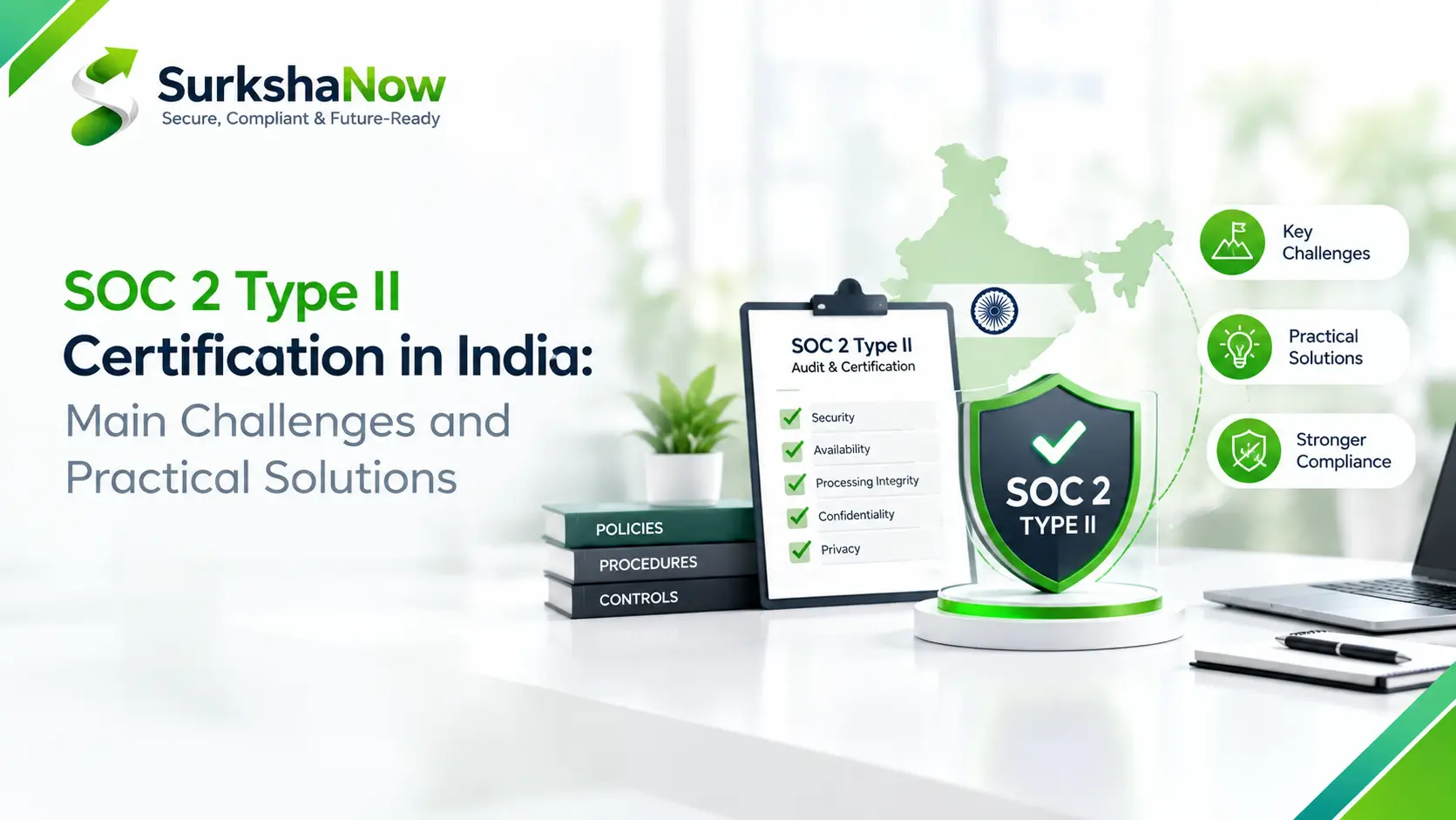
Although a SOC 2 Type I report only verifies your security posture at a single point in time, global markets require a SOC 2 Type II certification. This is the gold standard since it demonstrates that your security controls actually function effectively over a prolonged monitoring period (usually between three and twelve months).
Achieving SOC 2 Type II compliance in India is challenging. The major problems Indian companies face are outlined below, along with modern, automated solutions to address them.
The greatest surprise for technology teams during a Type II audit is the enormous amount of evidence required. Since the audit takes several months, manually obtaining point-in-time screenshots of code repositories, employee background checks, and cloud configuration histories becomes a huge task.
Engineering and IT teams often spend so much time on spreadsheets that they cannot focus on product development or other key business tasks.
Traditional SOC 2 compliance is often expensive for growing businesses. Indian companies may need to work with several vendors, such as one for readiness assessments, another for scanning, and a US-registered CPA firm for the final attestation.
This disconnected approach can greatly increase your SOC 2 compliance costs and make the process take much longer.
Indian enterprises cannot build their security frameworks in a vacuum. With India's Digital Personal Data Protection (DPDP) Act fully active, businesses must design security controls that satisfy global AICPA (Trust Services Criteria) guidelines while simultaneously respecting strict local data residency, consent management, and data subject rights. Mapping these overlapping requirements manually is incredibly complex.
In a SOC Type I audit, if a control is missing, you can fix it right before the auditor looks. In a SOC Type II audit, you can’t look backward.
Suppose an engineer turns off multi-factor authentication (MFA) on a critical repository for just a few weeks during your 6-month observation window; that creates an audit deviation. Catching these lapses retroactively is nearly impossible without continuous monitoring.
Getting enterprise-level compliance does not have to slow down your product plans. By switching from spreadsheets to automated platforms, Indian tech companies can build trust with clients more quickly.
| The Legacy Obstacle | The Modern Platform Solution |
| Manual Point-in-Time Evidence | Continuous Automated Evidence Gathering via API integrations with AWS, GitHub, Jira, and HR platforms. |
| Fragmented Vendor Expenses | All-in-One Compliance Suites that combine automated tool tracking, consulting, and CPA readiness. |
| Control Overlap Confusion | Unified Cross-Mapping Frameworks that satisfy SOC 2, ISO 27001, and India's DPDP Act under a single control set. |
| Undetected Security Deviations | Live Alerting Systems that ping your IT team the moment a cloud control drift occurs. |
If your business wants to pursue global contracts or is preparing for enterprise audits, managing multiple separate tools is a significant challenge. Instead of another disconnected dashboard, you need a complete compliance partner who understands the local market and has global credibility.
SurkshaNow bridges this gap by unifying technology and expert attestation under one roof.
SurkshaNow makes it easier for businesses in India to obtain SOC 2 Type II certification through automation; the platform reduces manual tasks, accelerates readiness, and simplifies evidence collection for audit teams.
Now that Surksha is available, businesses can simplify their compliance workflows, monitor their readiness, and create more robust audit packages without relying on endless spreadsheets. This is particularly beneficial for SaaS, IT, cloud, and service companies, which need to demonstrate their security maturity to global customers.
Going global shouldn't mean drowning in audit stress. With SurkshaNow, you can automate continuous compliance, build instant trust with international clients, and get audit-ready in weeks—not months.
Schedule Your Free Audit Assessment
Stop stressing compliance. Start scaling faster.
SOC 2 Type II certification assesses whether a company’s controls are properly designed and operate effectively over time, based on the Trust Services Criteria.
It helps Indian SaaS, IT, cloud, and service companies build trust with global customers and qualify for enterprise deals.
The most common challenges are manual evidence collection, a lack of in-house compliance expertise, incomplete documentation, and the consistent maintenance of controls throughout the audit period.
The timeline depends on your current security maturity, audit scope, and readiness. In most cases, preparation and the audit period together can take several months.
Typical evidence includes access logs, policy documents, incident records, vendor reviews, training records, and proof that controls were followed throughout the review period.
SurkshaNow helps simplify compliance by streamlining readiness, reducing manual work, and making evidence collection and control tracking easier.
Compare SOC 2 Type 1 vs Type 2 compliance. Learn key differences in timeline, cost, and requirements to choose the right report with SurkshaNow.
Read More →With the DPDP Rules notified, Indian businesses face strict compliance milestones leading to May 2027. Discover the phase-by-phase timeline, key requirements, and how SurkshaNow simplifies your DPDP Act implementation.
Read More →Don't let security vulnerabilities ruin your business reputation. Learn how to choose the right VAPT company in India and schedule your security audit with SurkshaNow!
Read More →